Friday, 31 October 2014

Haloween make-up

As it is the Haloween week our task was to create a Haloween make up. We were given sime images in order to help us in some way. the picture I chosen wasn't so difficult but as I have never done it before I found it quiet difficult and I also ran out of time.
And here is what I managed to do:


My fault was that as I have never done it before I thought that also the borders should be blended, so more I blended more the color spread. The only thing I'm happy with is the shape of the contouring and I also thing that it is nice blended. Another problem was that it was very itching for my model, so it was difficult to work with her. But of course it is a good experience for me because I'm sure during my working experience in the future I'll meet this problem quite often.
So after that disappointment I asked one of my flatmates to let me try again the Haloween make-up and here is the result which I'm really happy with:


Eye shadowing


  • After applying the base hold the eyebrow up and blend some translicent powder on the eye backwards and forewards. Touch it to ensure that it's not steaky.
  • Put an abundant amount of translucent powder under the eye as near the eye as you can, beacuse if the eyeshadow bits fall over that part you can easly remove it(brushing them away)
  • Using the same brush, scrape a bit of eyeshadow on the artist's pallette
  • Get your powder(eyeshadow) and put it on the back of the hand- in this way the excess will come off
  • Start with the lightest color. Go right up backwards and forwards.You can also highlight the part under the eyebrows with the same color
  • Take a darker color and put it on the back of your hand to make the excess come off and then go backwards and forwards on the edge of the eye. You can also go into the socket of the eye. Look through the mirror to see if you got it right in the socket.
  • For the eyeliner: Use an angled brush. Wet the brush, mix with an dark color till it will become a paste. Strech up and do the line along the edge of the lash. Go also along the low lashline. Do not open the eye if you use a liquid eyeliner, until it's dry.
    The eyeliner defines the eye and thickens the eyelash
  • Brush away the powder which is under the eye
  • For the mascara: Get a mascara wand. You can ONLY use it ONCE (in and out).
    You go down on the top to get the residue out, then right from the root go upwards. On the Bottom it's easier if you go across wiggling.
    If you get mascara on the face, take a cotton bud and some transluscent powder and remove it straight away. Do not let it dry.
  • With a natural color clean through the eyebrows from the powder.
BEFORE

POWDERING

FINAL WORK

IMPORTANT: 

1. If you do intense smoky eyes or you are using a lot of dark colors it is good to make eyes before applying the base. It is also used very often for catwalks.
2.  Whan taking eye shadows DI NOT DOUBLE- DEEP
3. When working with the eyeliner, you can put a tiny bit of tape on the eyeline to create a nice eyeline
4. If you are not pleased with your work or something went wrong, get a cotton bud and some powder and blend the mistake away.


The way that you eyeshadow dipends a lot on the shape of the eyes:


Neeta Madahar

    Neeta Madahar is a famous photographer born in 1966. She studied at Winchester School of Art and of the Museum of Fine Arts and Tufts University in Boston. Her works were exhibited most in Europe and the USA.


    Madahar's art is devided into two categories: One evokes the beauty in the mondane or meditations on useen wonders, while the second one is formed of portraits that resemble classic mid-20th century Hollywood glamour shots. The women she was/is working with, are aged in their 30s, 40s and 50s, and although carefully dressed and posed, maintaining anyway the natural look. This means that there was no attempts to disguise their age or temper with their looks: no airbrushing, soft focus or Photoshop.
    The sitters were involved in creating the overall image by selectingthe flowers and suggesting themes or emotions such as melancholy or innocence. Each sitter participated by deciding the tone and including an object that was personal to their personalities into the photo.
    Passionate about art as a child, Madahar was discouraged from pursuing it by her parents because it wasn’t a subject they considered serious or one that would help her support herself. In her mid-20s she started doing a weekly painting and drawing evening class, which fired her enthusiasm for art again and made her determined to pursue life as an artist.

I personally think that the great work of Neeta Madahar is a real art showed through her originality and creativity. Her perfection lies in the fact to show the imperfection, and this is what makes her unique.

Links related to the research:
http://www.aestheticamagazine.com/neeta-madahar
http://www.aestheticamagazine.com/wp-content/uploads/2010/10/37A-neeta.jpg
                                               https://blogger.googleusercontent.com/img/b/R29vZ2xl/AVvXsEjI5j6GDODuB9ZGG0_LQ7eab1Mx_19k1mLosHR-nN2MsrcZYRU-CNIvzSAlWvZ0tAA0YpfTzEXE0RUKju0pIGoPtJ9LsgwrQS8k0Gl8sNaRSQerRQodYPwU4Dralu993Zl7Js8RUI5tXt0R/s1600/Neeta+Madaha+-+Flora+collection+-+Diemar+Noble+Photography.jpg
http://info.umkc.edu/art/wp-content/uploads/2014/03/dressedup-madahar-620x273.jpg

Monday, 27 October 2014

Seven photographs that changed the fashion

     "Seven phoptographs that changed fashion" is a documentary film about a contemporary photographer- Rankin who tries to recreate 7 of his favourite images as he takes a brief though the history of the fashion photograph.
    The first picture he tried to recreate was the "White Panama Hat" from the Vogue magazine, in 1934 by Cecil Beaton. He tried first to take this photo with the camera which was used by the original photographer and the he did the same with a digital camera. The old camera which was used by Cecil, shows the image upside down- that means that photographers took the pictures ina formal way. One of the important things Rankin noticed is that in the actual picture he took with the old camera, the model had an enigmatic look, which is not there in the picture taken by a contemporary digital camera.
   The second photograph Rankin tried to recreate was the Vogue's cover from 1950 by Erwin Blumenfeld. In this pictures is noticeable the influence of surrealism. The original picture was taken in black and white. It was retouched at the printing stage. This is  proof that Blumenfeld's work was real art.  We can clearly see how easy is to create that kind of picture in nowadays with all those developed technologies. But the question I'm asking myself is "How did Blumenfeld manage to make it so perfect without all these technologies we have in our modern society?"

The third picture was "Dovima with elephants" made for Harpers Bazaar, by Richard Avedon in 1955. This picture fascinates me with its originality.


The fourth photograph was "Jean Shrimpton" from the Vogue magazine in 1963 made by Davin Bailey. Bailey was inspired by sex. This was a real inovation by those times, as such kind of pictures weren't xone before. This picture inspired Rankin intimity, so that's why he asked his girlfriend to be his model.
 Personally, I think that the picture Rankin tried to recreate eas quiet different from the original and it also didn't impress me so much. Of course it was a nice picture with a lot of glamour and charm in it, but it didn't fascinate me as it looks quiet common for the modern society.
The fith picture is called "Rue Aubriot" from the Vogue magazine, in 1975 taken by Helmut Newton. This image has a timeless look which personally I think it is in what consists its originality. He suggested that the fashion photographs can be more than a simple beautiful snapshot. Vibeke Knudsen who was the real model of Newton's photography, tells how professional he was. He always had a little distance between hin and the people he worked with. "He was the master..."-  This is what I also call "Professionalism". Being professional means, from my point of view, to be able to make difference between work and private life. It is like living in two different worlds at the same time. It is exactly what Newton did.
The sixth photograph was an Untitled picture from Vogue magazine in 1970 made by Guy Bourdin. At first sight it seems a very simple image, but it has to be unmistakeble to reach that kind perfection. He was able to create energy. He was completely controlling everything. He defenetly knew what he wanted. So, from my point of view it is another characteristic to follow: Ambition!...another characteristic a preofessional person MUST HAVE. One of the interesting things about Bourdin is that he hated being photographed because he thought it would steal his soul. This thing reminds me of one of my friend who also has the passion for the photiography.She adore taking pictures, but she never let herself to be photographed. This part of the film particularly captured my attentio for this reason.
The last photograph that Rankin tried to recreate was " Fred with Tyres" from Per Lui magazine, in 1984, made by Hebert Ritts. That time , men started to be the objects for desire. Herb was inspired from simple images about workers and denim. Rankin uses different cameras to recreate that picture. The pictures Rankin created are not exactly what Herb Ritts did, but it was quiet similar.
All these photographs show like a step by step inovation of photography's past.
 I liked a lot this film as it shows beayty, originality, history, passion and professionality, and all these things must be a part of every real artist.


Sunday, 26 October 2014

Extreme Contouring

The Extreme Contouring has the same features that the simple contouring has, but in a more poonted way. It is based on the concave and convex parts of the human skull. Observing the human skull, we can figure out what parts of the face we need to contour and which ones need to be highlited. That's why we usually highlight the parts where there are bones and we contour between bones (if paying attention at the human skull). This serves commonly to give a visual illusion o a slim face.
    The Extreme Contouring can be also done using a variety of colors, especially if it's used for beauty shots/ editorial work.


My verson of Extreme Contouring


The only thing I can say is that I have to practice a lot on this aspect, as I found it a bit difficult. But we are here to study, practice and improve our skills. 

Contouring. Step by step

1. You first start with applying the base.
2. Choose a dark concealer, ask the model to suck in the cheeks to find out the cheekbones and swipe a line under the chhekbones only to half way through the cheek.
3.  Contour also around the nose and under the chin to give a visual illusion of a slimmer face.
4.  Blend the counciler with a small brush. You can also blend it with the fingers.
5. Add some translucent powder on the base.
6. With a dark powder define the contoured areas.
7. Apply a highlighting powder on the nose, forehead, chin, cheekbones, corner of the eye and under the eyebrow which is where the light would naturally hit , and it will also put in evidence this parts during a photoshoot.
8. Ask the model to smile so that you can apply the blush on the cheeks  bringing it gently toward the temples.


Sunday, 19 October 2014

Elizabethan Portraiture and Symbolism


The picture is very engaging because the blue rose is not typical and makes you want to analyze the image further as roses are commonly red and associated with love, passion and lust. Whereas the rose has been edited in a way that symbolises something more mystirious and intriguing. The shade of blue is royal blue and contrasts against her skin making it very bold. Blue is a cold color which is often associated with emotions such as sadness and pain, this is reflected in the image as there is blood dripping from her mouth. This highlights the fact that the rose is perhaps causing her pain however the way she is posing shows that she is not afraid of the pain. The dominant colour in this particular image is also blue which is shown in the background and her eyes which again highlights the significance of the rose being blue. The garments which she appears to be wearing is black with a lace/shiffon type material that could be seen as something which is worn at funerals which again symbolises this idea of sadness. The intensity of the black is also contrasted with her bold eye make up which adds fierceness to this image. The only warm colour used is the red from the blood, and often warm colours is typically associated with happiness but in this context it adds to the coldness as it is quite unsettling. Interestingly even though in my opinion this image is portraying pain and perhaps evilness, it is also quite relaxing as the paleness of her face is very pure. This gives a sense of calmness and peace which in effect juxstaposes with the idea behind the blue rose piercing her lip and causing her pain.


     The Elizabethan portraits are full of Renaissance and Symbolism. Not only Queen's portraits, but also of other people from Elizabethan times.

The Sieve portraits

 For example in one her portraits Elizabeth has a sieve in her left hand. The sieve is the symbol of purity as she was The Virgin Queen.

The painting is like other works of this period, rife with allegory.According to Roman legend, a Virgin could carry water in a sieve, making it a logical symbol of the Virgin Queen. The globe on the upper left represents England's role in the age of exploration. The Latin motto above it- "Tutto vedo&Molto Mancha" means-" I see everything and much is lacking", signifying Elizabeth's leadership in imperial expansion.

Armada Portrait

This portrait is full of symbolism:
Pearls- like her mother befor her, Elizabeth loved pearls and in her portraits pearls symbolise purity and virginity. The pearls had an important meaning to Elizabeth as it is said that the pearls were the last Dudley's gift.
Ruff- her ruff frames her face as the rays of the sun
Window scenes- in the window of the left side of the painting there is the arrival of the Armada and then on the right there is the defeat of the Armada. This portrait could be seen as a tribute to Elizabeth's success of protecting the nation from Spanish invasion or there could be seen a areligious meaning: perhaps the ships are  beaing forced onto the rocks by the "Protestant wind"
Globe- Elizabeth's hand on the globe, we can see that her hand is over the Americas which England was busy colonising. Her fingers are extending to other parts of the globe and this symbolises that Elizabeth's poweris reaching and that the whole world is at her disposal.
Pillars- the Queen is flanked by two columns behind, probably a reference to the famous Impresa of the Holy Roman Emperor, CharlesV, Philip II of Spain's father, which represented the pillars of Hercules, gateway to the Atlantic Ocean and the New World.
The egg shaped object- on the right hand side of the painting there is an egg shaped object above Elizabeth's shoulder and in front of the window. It appears to be a pomegranate which symbolised fertility, generosity,union,prosperity, resurrection end eternal life.
The crown-confirmation of Elizabethan powerfull position.
Carving- a symbol of the potential destructive nature of females.

The Rainbow portrait


Elizabeth's gown is embroidered with English wildflowers, thus allowing the queen to pose in the guise of Astraea, the virginal heroine of classical literature. Her cloak is decorated with eyes and ears, implying that she sees and hears all. Her headdress is an incredible design decorated lavishly with pearls and rubies and supports her royal crown. The pearls symbolize her virginity; the crown, of course, symbolizes her royalty. Pearls also adorn the transparent veil which hangs over her shoulders. Above her crown is a crescent-shaped jewel which alludes to Cynthia, the goddess of the moon. 

A jeweled serpent is entwined along her left arm, and holds from its mouth a heart-shaped ruby. Above its head is a celestial sphere. The serpent symbolizes wisdom; it has captured the ruby, which in turn symbolizes the queen's heart. In other words, the queen's passions are controlled by her wisdom. The celestial sphere echoes this theme; it symbolizes wisdom and the queen's royal command over nature. 

Elizabeth's right hand holds a rainbow with the Latin inscription 'Non sine sole iris' ('No rainbow without the sun'). The rainbow symbolizes peace, and the inscription reminds viewers that only the queen's wisdom can ensure peace and prosperity. 

The Pelican portrait


Two imperial crowns – The crown on the left hand side of the picture is sitting on top of a Tudor rose and therefore symbolizes Elizabeth’s claim to England and the crown on the right hand side is sitting on top of a Fleur de Lys and so symbolizes Elizabeth’s claim to France.
The Pelican – Elizabeth is wearing a “pelican in her piety” pendant on her breast and this symbolizes her selfless love for her people, a mother’s love, because, according to legend, a female pelican would pluck her own breast to feed her dying young with her own blood. Also, as I said a couple of weeks ago, the pelican was also a symbol, in the Middle Ages, of Jesus’ crucifixion, the ultimate sacrifice, and of the Eucharist, the feeding of his followers with his own body and blood.
The colours of Elizabeth’s clothing – The National Maritime Museum point out that this portrait shows Elizabeth dressed in red, black, white and gold, colours that spoke of her wealth and status. Red fabric was dyed using cochineal, a dye restricted to those with serious money, and black fabric was notoriously expensive.
Tudor roses – As well as the Tudor Rose in the top right hand corner, you can also see Tudor Roses in the blackwork embroidery on Elizabeth’s sleeves and partlet. Even though Elizabeth has been queen for a while, she is reaffirming her Tudor roots and her right to the English throne.
Pearls – There are pearls on Elizabeth’s headdress, on her dress, and around her neck and shoulders, lots of them in fact. These symbolized Elizabeth’s purity and virginity.

The Ermin portrait

The Ermine- was the symbol of royalty; the animal is wearing the gold crown it wears. The crown symbolizes majesty and purity. 
The bejeweled black gown and background - black and white were the queen's favorite colors. Also, the deep, dark color reinforces the symbolic gravity of the painting.
 'Three Brothers' jewel - a gem made of three diamonds set in a triangle around a pointed diamond. It was one of her most treasured jewels.
 The sword -on the table beside the queen and symbolizes justice; she also holds an olive branch to symbolize peace.


Introduction to the brief


My name is Mihaela and I am an international student at Southampton SolentUniversity. I am original from Moldova, but I raised some years in Italy. I've chosen this course because of my passion for the beauty, because of my admiration for the art and because of my desire to make other women feel themselves beautyful...for putting in evidence the femminity.


The first assignement is called " The New Elizabethan".
It concistsof searching an Elizabethan Portrait on which I can bace my work.I have to analyze it in minimum 250 words. The second task is to find a contemporary famous person's  picture which is similar from my point of view to that Elizabethan portrait, and write another analysis to that portrait.
The final task is to mix the characteristics of these two images and to create a New Elizabthan Look.
I'm very excited about this project but also quiet anxious as well. I think that this project gives everyone the opportunity to express ourselves and at the same time it will highlight the originality of each of us. This is the right opportunity to let the green light to our creativity.
 I'm also anxious because I fear that with my current skills having only previously done a three month basic level course in make-up, I may not be as strong as other candidates. However, I know that working alongside everyone and being enriched with more in depth information and practical tasks within this course, it will push me to the limit in which I can reach my goal.
In regarding to the topic focusing on the Elizabethan era, my undestanding of the era is very minimal as I am not particularly familiar about the history of it. However, I try to get weel-informed about that specific era and thanks to our lectures it is easier and keeps being also very interesting. I've discovered new things and I became more attentive at small details. Now I can affirm that i really understand how our past was important to our present and which could be it's impact on the future.

Friday, 17 October 2014

Color Theory

In visual arts, Color theory is a body of practical guidance to color mixing and the viasual effectsof a specific color combination.
The relative atributes that define all colors are:

  • Lightness
  • Saturation
  • Hue
The first circular diagram was developed in 1666 by Isaac Newton.


The circular diagram contains : primary colors, secondary colors and tertiary colors.
The primary colors are Red, Blu and Green.

A mix between 2 primary colors form a secondary color.

Analogues colors- are groups of colors that are adjacent to each other on the color wheel,with one being dominant color which tends to be primary or secondary color and two on other side complementing.
An analogue color scheme creates a rich,monochromatic look.
Complementary colors- any of two colors which are directly opposite each other on the wheel.

Achromatic colors- white, black, all shadows of grey and all neutral colors

Chromatic colors- highly colored

Monochromatic color- all colors of a single hue

Color context- how colors behave in relations to other colors and shapes

Color harmony- can be defined as a pleasing arangement of shapes or colours. Something that is pleasing for eyes.


Monochromatic face chart

This face chart will also be used for the Digital Image Production 1 project. It's topic is freedom and the mood I tried to represent is Relief.

Achromatic face chart


What was happening in Europe in Elizabethan age?


  1. In 1517 started the Prostentant Reformation by Martin Luther.
  2. The Scientific Revolution started by Nicolaus Copernicus, when he sais that the Earth rotates around the sun and not the other way round.
  3. The European people increased in literacy.
  4. The Renaissance had overwhelmed Italy and was slowly moving throughout the East Europe.
  5. Many artists were receiving more commissions from private sources and had made the switch from tempera to oil.

Tuesday, 14 October 2014

Film analysis

Elizabeth(1997)

Elizabeth is a 1997 biographical film written by Michael Hirst, directed by Shekhar Kapur.
Ctae Blanchett was starring in the role of Queen Elizabeth I. This film is based on the early years of Elizabethan era.
The Australian actress Blanchett won several awards for her portrayal of Elizabeth, notably a BAFTA and a Golden Globe, while the film was also named the BAFTA Best British film. Cate Blanchett in the role of the Queen Elizabeth was nominated in 7 categories in the seventu first Academy Awards, including also the Best Picture and the Best actress, receiving another prize for BEST MAKE-UP.
Jenny Shircore was Cate Blancett's hair and make-up designer, while Morag Ross was the hair stylist and the make-up artist.

Fire over England

Fire Over England is a 1937 drama film. It was directed by William K. Howard and written byVlemence Dane from the novel Fire over England by A.E.W.Mason. 
    In 1588, relations between Spain and England are at the breaking point. British sea raiders regularly capture Spanish merchantmen bringing gold from the New World with the support of Queen Elizabeth I. After a plot to depose her is discovered, she enlists Michael Ingolby, whose father was killed by the Inquisition, to go undercover and infiltrate the court of Philip of Spain. Masquerading as one of the traitors, Ingolby finds the names of British subjects in Spanish pay. He identifies the would-be assassins and discovers their plans to send the Armada against England. His feats earn Ingolby the love of a Spanish noblewoman, an English courtesan, and Queen Elizabeth herself as he takes the British fleet into battle. At the climax he leads a night attack on the Armada ships massed off the coast of England.

The Virgin Queen

The Virgin Queen is a 1955 Historical drama film starring Bette Davis, Richard Todd andJoan Collins. It focuses on the relationship between Elizabeth I of England and Sir Walter Raleigh.
This film tells how Sir Walter Raleigh gains audience with Queen Elizabeth I and soon wins her over to his way of thinking. He wants ships to sail and make a name for England. A young ward of the court, Beth Throgmorton, is strongly attracted to Raleigh and returns the attraction. But soon the Queen shows her desires and he bends in order to achieve his goal of ships. But still he loves Beth.
The costumes were designed by Mary Wills and she was nominated for the Academy Award for Costume Design.
The make-up was created by Ben Nye and Perc Westmore, while the hair staylist was Helen Turpin.

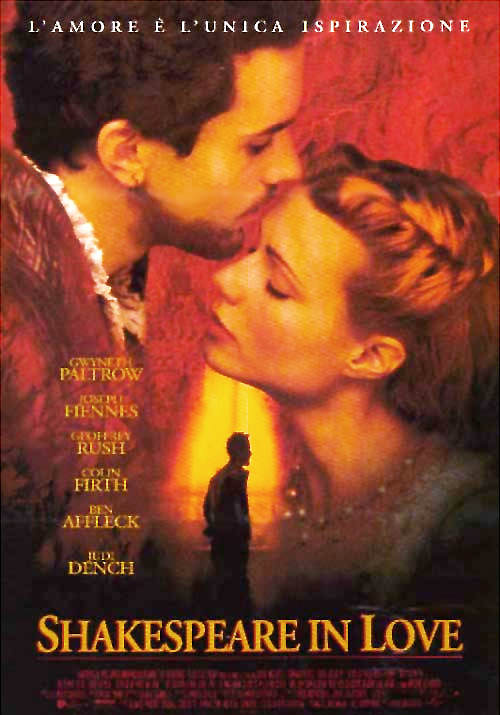
Shakespeare in love

Shakespeare in Love is a 1998 British-American romantic comedy-drama film directed by John Madden and written by Marc Norman. The film depicts a love affair involving Viola de Lesseps (Gwyneth Paltrow) and playwright William Shakespeare (Joseph Fiennes) while he was writing the play Romeo and Juliet. The story is fiction, though several of the characters are based on real people. In addition, many of the characters, lines, and plot devices are references to Shakespeare's plays.
Shakespeare in Love won seven Academy Awards, including Best Picture, Best Actress (Gwyneth Paltrow), and Best Supporting Actress (Judi Dench).
The film is about Will Shakespeare is a known but struggling poet, playwright and actor who not only has sold his next play to both Philip Henslow and Richard Burbidge but now faces a far more difficult problem: he is bereft of ideas and has yet to begin writing. He is in search of his muse, the woman who will inspire him but all attempts fail him until he meets the beautiful Viola de Lesseps. She loves the theatre and would like nothing more than to take to the stage but is forbidden from doing so as only men can be actors. She is also a great admirer of Shakespeare's works. Dressing as a man and going by the name of Thomas Kent, she auditions and is ideal for a part in his next play. Shakespeare soon see through her disguise and they begin a love affair, one they know cannot end happily for them as he is already married and she has been promised to the dour Lord Wessex. As the company rehearses his new play, Will and Viola's love is transferred to the written page leading to the masterpiece that is Romeo and Juliet.
The costume designer was Sandy Powell.
People responsible for make-up and hair design were:

  • Julie Darnell- hair stylist and make-up artist
  • Karen Ferguson- hair stylist and make-up artist
  • Tina Earnshaw- make-up designer
  • Kay Georgiou- hair designer
  • Philippa Hall- make-up artist and hair stylist
  • Deborah Jarvis- make-up artist and hair stylist
  • Veronica McAleer- Senior hair stylist
  • Lesley Smith- hair stylist and make-up artist
  • Lisa Westcott- hair and make-up designer
  • Anita Burger-  hair stylis 
  • Demelza Rogers- daily make-up and hair/ make-up artist
  • Caitlin Tanner-dailies make-up artist
  • Vicky Voller-crowd hairdresser

I personally think that in all of these films the portrail was very acurate. Some of the films such as Elizabeth(1997) and The Virgin Queen reflected very well some particular aspects from what I've seen when I have visited The National Portrait Gallery. For example in this film( Elizabeth), the make-up and hair is very similar to what old portraits show. This is really interesting how the talent of the artists, stylists and designers can magically bring back the viewer in a very distant past.

Tudor cosmetics

Tudor Make-up and Cosmetics

Use of cosmetics or make-up was frowned upon at some points in history. Not so the period of the Tudors. The rich women of the Tudors, Royality and the Nobilty, wore make-up as an indication of their status or rank. Make-up also had a practical use to hide the scarring of various diseases such as smallpox.

The Elizabethan era

Queen Elizabeth I set the fashions and as she grew older she more wore elaborate make-up which was usefull for hiding wrinkles and other signs of ageing. Queen Elizabeth had contracted smallpox which had left some slight scarring on her face. As she grew older the heavy white make-up which she favoured helped to hide this and maintain her illusion of beauty and the image of the "Virgin Queen".

The ideal Tudor woman

The Tudor view of pure beauty during the Elizabethan era was a woman with light hair and a snow white complexion which was complimented with red  cheeks and red lips. A pale complexion could only be achieved by a weathy woman of the upper class. Poor women were axpected to work outside and therefore acquired a suntan. The pale complexion was therefore a sign of wealth and nobility-an immediate identification for a person from the rich upper classes.

White make-up by Tdor women

Queen Elizabeth had the natural attributes of this ideal image of beauty but  she enhanced and exaggerated the image by using white make-up. This expalins the odd white face make-up seen in manu of her portraits. The favoured application of the upper classes was called Ceruse which was a mixture of white lead and vinegar. Unfortunately was poisonous. The acquisition of a pale complexion was so  desirable that rich Tudor women were bled to achieve the desired pale look. Face paint made from plant roots and leaves was also applied. The look was completed with an application of an expesive rouge made from cochineal to stain the cheeks and the lips. Madder and vermilion was also used to achieve this reddening effect. Kohl was used to darken the eyelashes, another element of make-up which was emported from the Middle East during the crusades.